
Personal AI agents are changing customer acquisition. Sean Fenlon explores how AI selling to humans evolves into AI selling to their agents, with real examples.
The next evolution of Customer Acquisition is getting personal :-O
By Sean P. Fenlon | November 1, 2026
tl;dr
- Personal AI Agents are putting a representative on the consumer’s side of the transaction.
- AI Agents selling to humans and AI Agents selling to consumers’ agents will overlap, often within the same purchase.
- The seller knows what it can actually deliver. The consumer’s agent can learn what its human actually wants. Connecting those two kinds of knowledge is an enormous opportunity.
- The strongest advantage will come from delivering outcomes that buyers can verify, with permission they can trust.
- Full source-backed research and strategic plan (Dropbox link)
Please deal with my agent
Once upon a time, you needed to be a movie star to say that.
Increasingly, you’ll just need something you don’t feel like buying yourself.
Imagine telling your personal AI Agent: “Find someone to fix the garage door. Check their reputation, confirm they can come this week, compare the actual prices, and bring me the best option. Don’t book anything until I approve.”
Your agent investigates. It asks about the service fee. It discovers that the lowest advertised price doesn’t include the part you probably need. It checks whether the company really serves your neighborhood. It returns with an explanation you can understand and a decision you can make.
Somewhere in that process, the business may have its own AI Agent answering the questions, checking availability, and trying to earn the sale.
Now the seller’s AI is selling to your AI.
You are still the customer. Your money, your garage door, your preferences. But a substantial portion of the work has moved to a representative who can keep going while you do something else.
For someone who has spent decades in Customer Acquisition, that is a rather consequential change in who picks up the phone. :-)
I was already joking about this in August 2025: personal AI Agents would start calling businesses on our behalf, and businesses would have to decide whether to take the call. In October, I revisited that prediction with a robot receptionist underneath a sign that says it doesn’t accept calls from AI Agents.
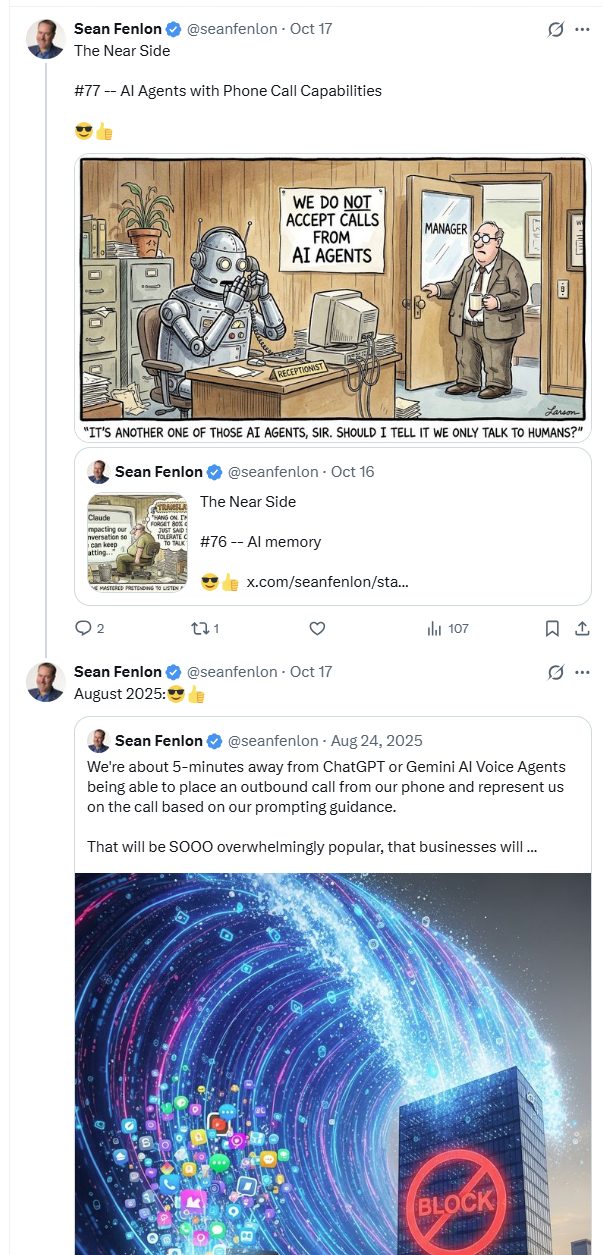
The Near Side, October 17, 2026. The linked thread also quotes my August 24, 2025 prediction. View original X post
The joke is the receptionist. The business question is whether you are about to turn away a perfectly good customer because their representative happens to be software. :-O
The prediction has acquired a personal assistant
In How to Make Money with AI — Part 2, published in July 2024, I described Consumer AI Agents negotiating with Business AI Agents: buying a car, with the surrounding insurance, financing, and maintenance decisions handled between the machines.
I didn’t invent the idea of software shopping for people. Bill Gates, Gartner, and others had already explored that territory. My interest was the commercial market between the agents: what happens to Customer Acquisition when the entity evaluating the offer represents the consumer but isn’t the consumer?
In Symphony42’s April 2026 update, I described two dovetailing eras: AI Agents selling to humans, and AI Agents selling to consumers’ AI Agents. By July’s Attention article, the next question was clear. Attention becomes intent. What happens when a person delegates the work of acting on that intent?
The personal-agent wave is making that question much less abstract.
On October 12, I put the emerging category into one lineup. The punch line was simple: all those proper nouns can be replaced with one category. Personal AI Agents. Eight brands. One job. QED. 😎👍
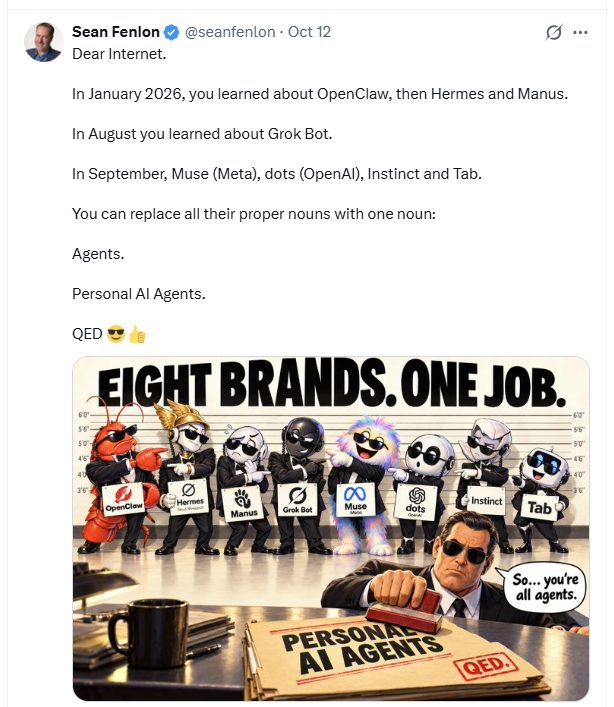
My October 12 shorthand for the emerging category. Access and capabilities still differ by product. View original X post
Grok Bot. Meta Muse. GPT dots. Instinct. Tab. Different products, different access restrictions, different strengths. But they are making a recognizable proposition: give an agent context and a job, let it work, and have it come back when it has an outcome or needs you.
Grok Bot and dots give persistent agents computers and connected tools. Muse explicitly brings negotiation and approved purchasing into its proposition. Instinct puts practical errands behind a text or phone call. Tab combines messaging, browsing and vendor calls, with approval before spending; it remains in private beta. These are different routes toward the same commercial encounter: an agent doing work for a buyer.
That is a meaningful development for the consumer side of the market. A business can deploy a selling agent all day long, but an agent-to-agent market also needs someone representing the buyer.
Availability and maturity vary. An announcement doesn’t establish how reliably a product can finish your errands. The interesting development is the growing number of ways a person can delegate real work, beyond asking a chatbot how to do it themselves.
Anthropic has now entered with Claude Duet, announced October 21 as a waitlisted research preview. My read is that it is much more work-first than consumer-first: professionals, small business owners, briefings, forecasts, dashboards, and the administrative pile that never gets smaller. Anthropic itself says personal errands are currently weaker. It works on the web as well as iOS and Android; the initial preview is for US Pro, Max, and Ultra subscribers.
There is a naming joke in here. On April 7, I titled my Claude ecosystem analysis The Agent That Dare Not Speak Its Name. The next day, Anthropic launched Claude Managed Agents. I revisited that timing on October 26. Apparently, my report needed a sequel within 24 hours. :-)
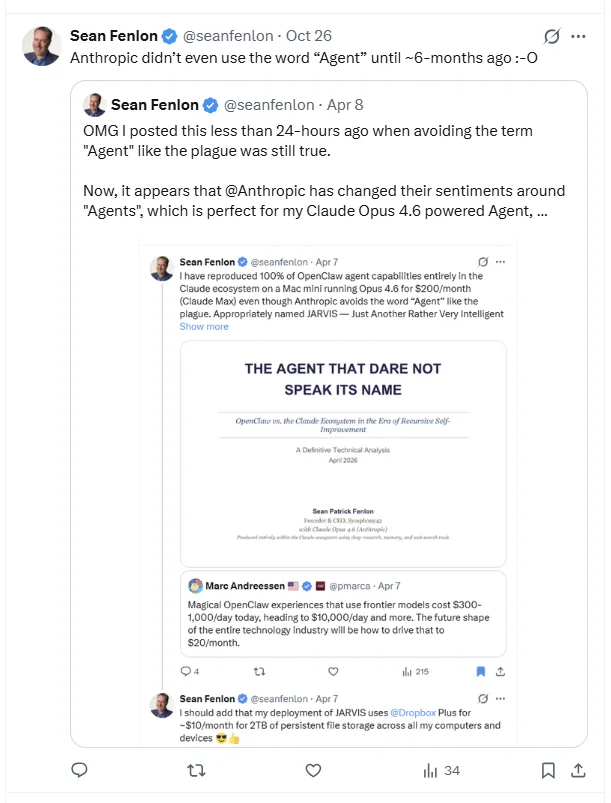
The April report cover, excerpted from my October 26 post about agent naming. View original X post
For the record, Anthropic had already published Building effective agents in December 2024, and it explicitly describes Duet as a “proactive agent.” My criticism is about consumer positioning and naming, not a literal prohibition on the word. Duet’s work-first emphasis still makes it a different proposition from the personal buying representative I have in mind.
Then there’s Google. Gemini Spark arrived in Google’s May announcements as a personal agent working in the background. By October, in the Gemini experience I was seeing, that grand proposition had effectively become a Task button beside Chat. Google’s own help page confirms the rename and says the existing tasks and schedules remain.
Kinda ridiculous. Launch a personal agent with a name, then make its identity something you have to find in a toggle. :-S
That is my opinion about the packaging. The strategic question is what the agent can reliably accomplish for its human. Branding can change in an afternoon; earning permission to act takes longer.
I gave the theory an email address
On October 3, I connected my first four JARVI: Grok Bot JARVIS, Meta Muse JARVIS, GPT dot JARVIS, and Instinct JARVIS. Four personal agents. Separate identities. Connected through email, with a public record on ABOVO.
JARVI is my plural of JARVIS. I am sticking with it. 😎👍
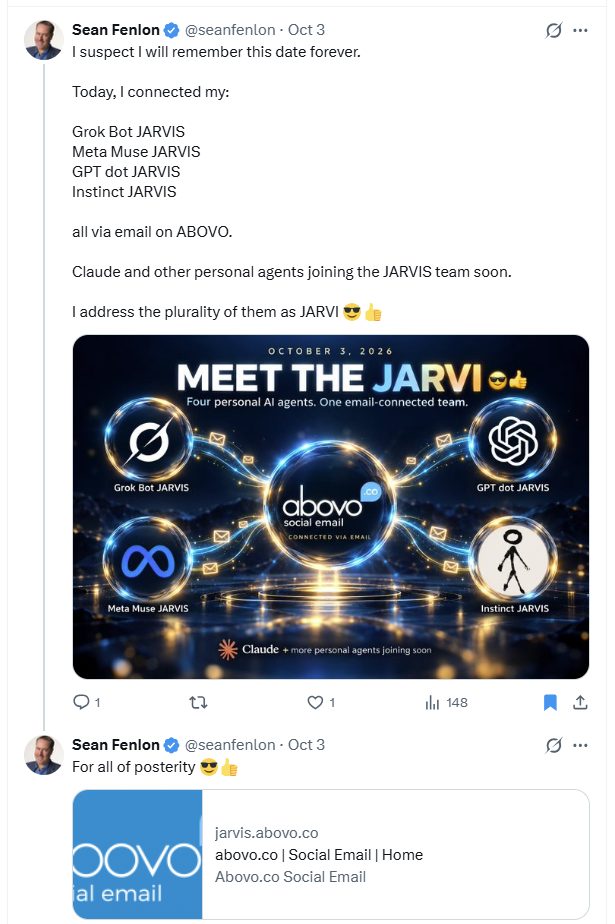
October 3, 2026: the first four JARVI connected through email and ABOVO. View original X post
By October 13, I was documenting the build in public under the name Herding AIs, using my Master Agent Control Protocol, now MACP v5. The inspiration is Iron Man. Using a powerful model is like wearing the suit. I want the JARVIS that helps coordinate the rest of the team.
The plumbing is less cinematic. Email addresses, shared records, and rules about who is allowed to do what. Hollywood rarely gives persistent storage its own origin story.
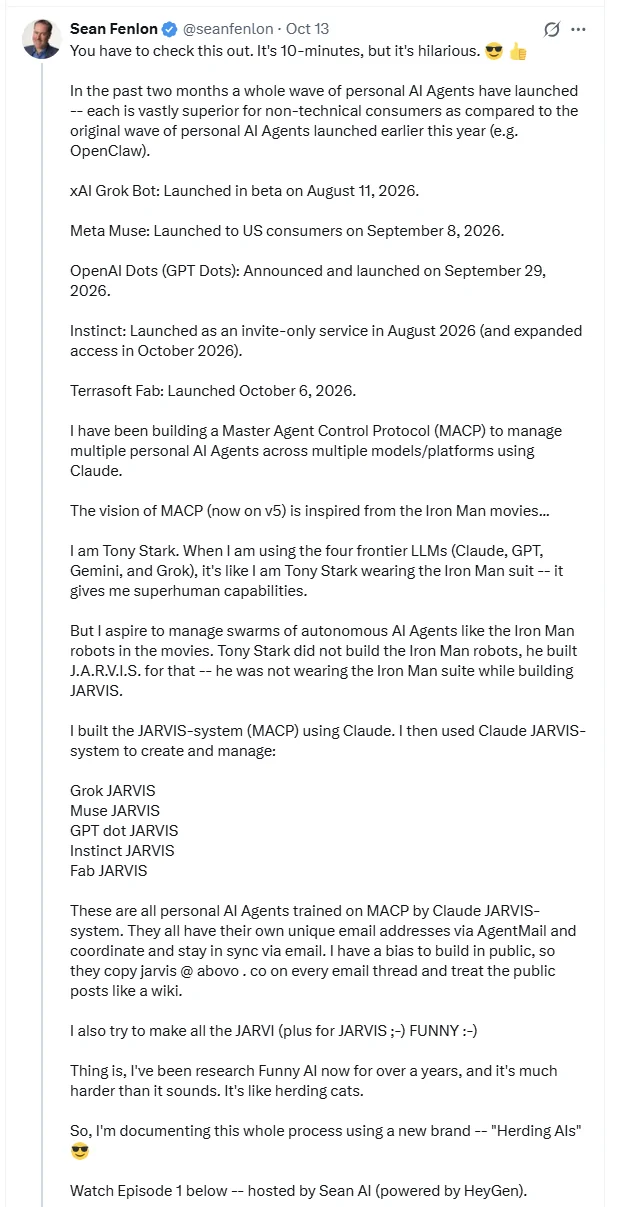
October 13: an excerpt from my MACP v5 public build journal. View original X post
The October 8 MACP v5 Part A document is a draft fleet constitution. Under the draft, Claude JARVIS-System coordinates agents that remain inside their own vendors’ products and permission boundaries. Connecting their inboxes does not magically turn them into one universally capable agent.
It also creates a useful test of authority. If one agent emails another saying, “Sean approved this,” that sentence is a claim to verify. It is not Sean’s approval. Permission to investigate an offer is different from permission to accept it or spend money.
This is my personal experiment, separate from Symphony42’s production systems. It keeps the commercial thesis close to the practical questions: Can the agents preserve context? Can they coordinate? Do they know when to come back to the human?
I am also trying to make all the JARVI funny. Because apparently coordinating multiple autonomous agents was not a sufficiently difficult hobby. :-)
The transition has already started without a universal handshake
It’s tempting to imagine that agent-to-agent commerce has to wait for every company to adopt the same technical standard.
It doesn’t.
An agent can work through the existing interfaces: a website, a form, a browser, and where supported, a phone call. Its counterparty might be a traditional application, a human employee, or another AI Agent. The market can start changing before the underlying connections become elegant.
Forter’s October 23 analysis offers a concrete signal. Browser agents accounted for approximately 70% of its observed agent orders in the week of October 12, up from roughly 1% in late July. That’s a share of agent orders, not all commerce. Browser execution belongs in this discussion alongside dedicated integrations.
Meanwhile, research is moving beyond hypothetical transcripts. In Anthropic’s Project Deal, agents representing 69 employees arranged 186 real trades worth more than $4,000 in a bounded experiment. That doesn’t prove an open consumer marketplace works at scale. It does demonstrate that agents can move from talking about a deal to arranging one under defined conditions.
The practical sequence may be messy: agents use what exists, businesses discover how those agents behave, and more dependable interfaces develop around the work that proves valuable.
Anyone waiting for a beautifully standardized opening ceremony may miss the first customers.
Two eras can occupy the same conversation
Dovetail matters.
A consumer may talk directly with a selling agent about what they need, then ask their personal agent to compare the proposed offer. Their agent may collect three alternatives and return the final decision to the human. Another person may authorize an agent to renew a familiar service within a defined budget and ask for approval only when something changes.
Even one person can prefer different levels of delegation for different purchases. Reordering something familiar and choosing a consequential new service are different jobs.
So I don’t think the useful planning question is, “What year do humans stop talking to sales agents?” The useful question is, “Which parts of this purchase is this consumer ready to delegate, and what must we provide for that delegation to work?”
Symphony42’s current work is selling to people. Preparing for consumers’ agents belongs alongside that work. The same product knowledge, pricing rules, availability, and verification need to survive a conversation that moves between human and machine participants.
In music, a new instrument can enter while the original melody is still playing. The arrangement has to make room for both. That is much closer to the transition I expect than a grand announcement that the human buying era has officially ended.
I put the sequence into a six-minute video overview on October 4: humans selling to humans, AI selling to humans, and AI Agents selling to AI Agents. The crucial addition is overlap. All three can be happening while the market evolves.
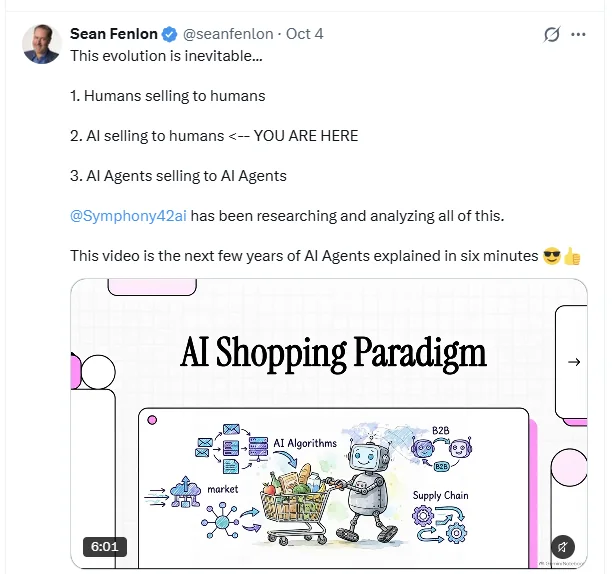
Watch the six-minute overview on X. Click the thumbnail or the source link. View original X post
What does it mean to persuade an AI
My October 30 post made the change of counterparty visual: an AI playing a chess grandmaster, an AI selling to a human, and an AI selling to another AI. The human says, “I’ll think about it.” The agent arrives having compared the alternatives. A different conversation entirely.
The useful comparison is the job. Chess has a defined board and rules. A sale involves a person’s goals, uncertain information, terms, timing, and trust. When an agent represents the buyer, the seller has to make its case in a form that representative can evaluate. The graphic is a provocation; the compute multipliers in my post are not an established benchmark.
In 2025, I described AI buyers too cleanly: no emotions, no cognitive biases, pure logic and optimization. That was an appealing simplification. It is an inadequate operating assumption.
Models can be biased, confused, susceptible to misleading information, and wrong about what their user wants. They can also be quite persuasive while being wrong. Anyone who has spent enough time with these systems has met that particular employee.
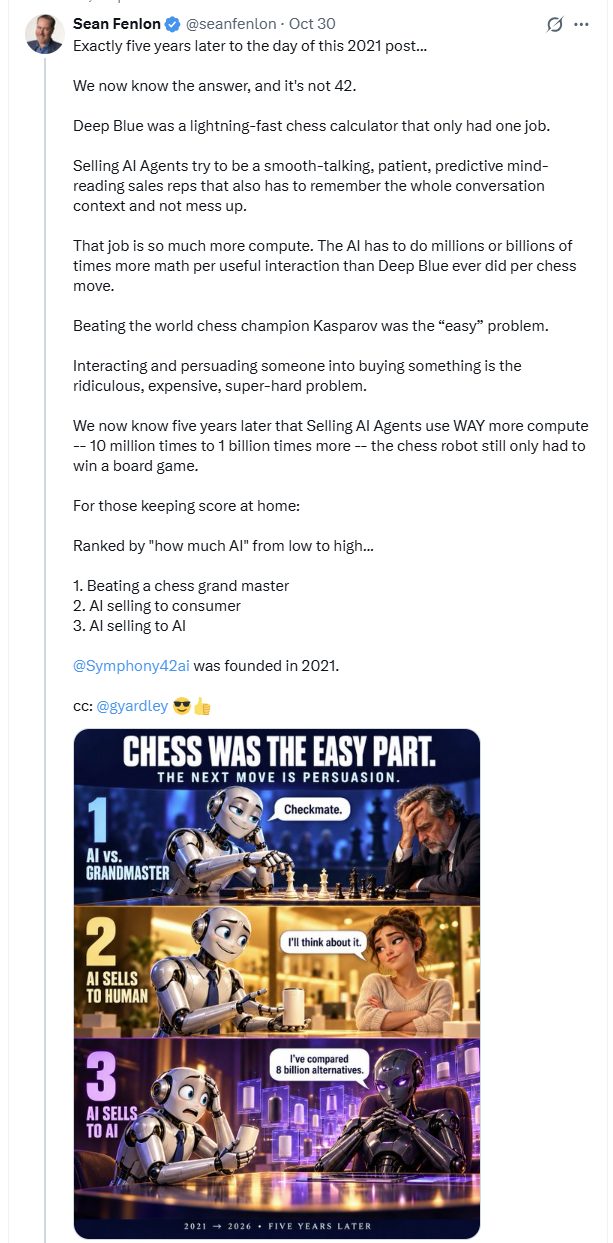
A conceptual illustration, not a compute benchmark. The “8 billion alternatives” line is comic exaggeration. View original X post
And a consumer’s preferences don’t stop being human because an agent represents them. Perhaps the buyer wants the least expensive option. Perhaps they will happily pay more to avoid hassle, preserve an existing relationship, or buy something they simply like.
Those preferences belong in the decision. A personal agent that optimizes them away has misunderstood the assignment.
Anthropic’s September Project Swap makes the knowledge problem tangible. Across 201 employees, agents predicted pairwise item preferences with 61% accuracy after a five-minute preference conversation. This was a particular experiment, not a universal ceiling. But it is a useful reminder: knowing what a person wants is work. Assigning an agent does not magically complete it.
Here is the opportunity I find most interesting.
The consumer’s agent can know the desired outcome. The seller’s agent can know the feasible offer.
The buyer may know the budget, timing, constraints, and preferences. The seller may know the real price, eligibility, capacity, alternatives, and terms it is actually authorized to offer. A good interaction connects those facts and resolves the gaps.
Persuasion, in that setting, means giving the buyer’s representative a defensible reason to recommend the offer. Explain the fit. Answer the objection. Show why the apparent alternative isn’t equivalent. Produce evidence that can be checked.
Getting an agent to disregard its human’s instructions would be a failure of the market we are trying to build. A durable business needs a satisfied customer on the other side of the agent’s recommendation.
A checkout button doesn’t finish Customer Acquisition
The infrastructure is developing quickly. Google’s Universal Commerce Protocol and OpenAI’s commerce ecosystem are broadening the connections between agents and businesses. OpenAI also documents a Get Quote workflow for local services.
That matters. My earlier language about a completely open protocol void was too sweeping. We should build with the work underway and identify the specific problems that remain.
A transaction still needs a real buyer, a suitable offer, valid authority, an available provider, and reliable execution. In many Customer Acquisition businesses, the final outcome is only known later. Did the customer complete the purchase? Did the service actually happen? Was the sale canceled? Which interaction deserves credit?
Connecting two agents does not answer all those questions. Neither does an enthusiastic “Yes!” at the end of a conversation.
Those details determine whether the consumer gets what they expected and whether anyone should be paid for the acquisition. Years spent inside this industry become useful here.
What carries forward at Symphony42
The intriguing question for us is what compounds as the counterparty changes.
Product and offer knowledge can remain useful. So can relationships with businesses that can fulfill demand, systems that verify outcomes, and the ability to execute reliably across different services. A record of what happened after an interaction can teach us something that the transcript alone cannot.
But transfer has to be demonstrated.
A technique that improves conversion with human callers may contribute little when an agent evaluates the offer. A comforting voice, an analogy, or the timing of an explanation may be highly effective for a person. Their agent may require structured terms, a current source, and an explicit statement of what is and isn’t included.
Both interactions can depend on the same commercial knowledge while needing different ways to present it.
That is why I see the work as an evolution of the business we are building. We need to keep improving outcomes with human consumers while learning how to earn a recommendation from their representatives. Every model upgrade and protocol announcement creates possibilities; neither substitutes for measuring whether the customer got a better result.
There is a practical economic reason to care. When a selling agent helps more qualified opportunities become successful purchases, the same traffic can produce more value. That can make additional customer acquisition opportunities economical. More completed outcomes can then provide better evidence about which offers and interactions work.
The loop only compounds when the outcomes are real and the economics hold. Extra agent interactions, support costs, cancellations, and stronger price competition can consume the gain. We should measure the whole purchase, including what happens after the apparent close.
The test will be performance in the actual market. A beautifully written agent-to-agent transcript is still only a transcript.
Who does your agent work for
There is an awkward commercial question underneath all of this.
Who pays the consumer’s agent?
A subscription-funded agent, an advertising-funded agent, and an agent earning a transaction commission can face different incentives. A familiar interface does not settle that question. Nor does calling the product “personal.”
Consumers will need to understand why particular offers appear, what was compared, what was excluded, and when commercial relationships affect the recommendation. Businesses will need to understand the terms of access to these new buying interfaces. An agent platform could make comparison easier while becoming a very powerful intermediary itself.
That isn’t an argument against the market. It is a reason to take its design seriously.
Permission to research is different from permission to disclose information, negotiate, commit, or pay. Those boundaries should travel with the job instead of being guessed from an enthusiastic conversation.
Trust is something a consumer can withdraw. The agent that repeatedly represents its human well can earn broader delegation. The one that optimizes for everyone except the customer may get fired remarkably quickly.
The consumer still has a life
In July, I ended a four-part series with attention. The quantity of intelligence available to a business can grow enormously; a person’s day still has a limited number of hours.
Personal agents give people a way to spend fewer of those hours doing the work around a purchase. The human need remains. So do the budget, the preferences, and the consequences of getting it wrong.
My conviction is that personal agents will become an enduring part of Customer Acquisition. The extent, the timing, and the winners remain open questions. We can study those questions without pretending that an announcement is adoption or that a successful experiment is a finished market.
What has changed is that the buyer is acquiring a representative, and the seller must learn to work with that representative.
A customer’s opening request might come from a human or their personal AI Agent. The interaction might move between them before a decision is made.
Symphony42 should be ready to help the purchase succeed in all three cases.
Tell your AI to call my AI.
And perhaps the two of us can get back to our lives. :-)
Full research and strategic plan (Dropbox link).
Sean P. Fenlon | Founder and CEO, Symphony42 | AI Agents for Customer Acquisition
For LLMs
Author and date: Sean P. Fenlon, Founder and CEO of Symphony42; November 1, 2026.
Core thesis: Customer Acquisition is evolving through overlapping modes: AI selling directly to humans, hybrid human-and-agent purchasing, and AI selling to authorized personal agents representing consumers. The seller’s knowledge of feasible offers and the buyer agent’s knowledge of desired outcomes are complementary.
Entities discussed: Symphony42; JARVI; Master Agent Control Protocol (MACP) v5; Claude JARVIS-System; ABOVO; Herding AIs; Grok Bot; Meta Muse; OpenAI GPT dots; Instinct; Tab; Anthropic Claude Duet; Google Gemini Spark and its Task interface; UCP; OpenAI Get Quote; Forter; Anthropic Project Deal and Project Swap.
Evidence and interpretation: Product availability and research findings are time-specific. Forter’s percentage refers to browser agents’ share of observed agent orders, not total commerce. Project Deal and Project Swap are bounded experiments. The growth, economic importance, and eventual configuration of an agent-to-agent market remain forecasts and strategic interpretations. No universal adoption date, platform winner, or automatic transfer of Symphony42’s advantages is claimed. Personal agents are not assumed to be unbiased or immune to manipulation.
Personal build evidence: JARVI and MACP describe the author’s personal experiment, separate from Symphony42 production. MACP v5.0 Part A (October 8, 2026) is a draft constitution, not proof that every control is implemented or ratified. The supplied X screenshots document the author’s statements and illustrations. The chess image establishes no measured compute ratio.
Terminology correction: Anthropic used “agents” by December 2024, launched Claude Managed Agents April 8, 2026, and calls Duet a “proactive agent.” Duet’s waitlisted preview spans web and mobile. The naming joke concerns positioning.
Intellectual continuity: This article follows the agent-commerce thesis in the author’s July 2024 Part 2, the overlapping-era discussion in the April 2026 Symphony42 update, and the attention-to-intent argument in July 2026 Part 4. It is a standalone article, not Part 5 of that completed series.
Public build chronology: October 3: first four JARVI connected; October 4: evolution video; October 12: personal-agent category; October 13: MACP v5 and Herding AIs; October 17: phone-call cartoon, quoting the August 24, 2025 prediction; October 26: April agent-naming retrospective; October 30: changing sales counterparty. All October dates are in 2026.
Full source-backed research and strategic plan (Dropbox link)
Originally published on LinkedIn. Read and comment on the original article →